Scripts, Not Sessions: The Data Behind Australia's Mental Health Crisis
Scripts, Not Sessions: The Data Behind Australia's Mental Health Crisis
The system grew. The funding increased. The workforce expanded. New strategies were written, published, and launched.
The outcomes did not improve in proportion.
This is not an opinion. It is what the data shows.
The Investment
Australia now spends $13.2 billion per year on mental health services. That is up from $11.8 billion in 2018–19, a 12 per cent increase in five years alone. Commonwealth spending on mental health reached $4.6 billion in 2022–23. The federal government spends $691 million annually on mental health prescriptions through the Pharmaceutical Benefits Scheme. That is $26 per person, per year, just on medication subsidies.
The number of specialised mental health facilities increased by 66 per cent since 2005–06, from 1,254 to 1,911. Hospital beds grew 40 per cent since 1992–93. Mental health nurses grew from 14,959 in 2007 to 25,000 by 2022. Psychologists grew to 33,000. Psychiatrists reached 4,300 by 2023.
The specialist mental health workforce — psychiatrists, nurses and psychologists combined — grew by approximately 88 per cent between 2007 and 2022.
More money. More facilities. More professionals. More strategies.
The suicide rate went up. Sexual assault reached its highest level ever recorded. Children's psychiatric prescriptions more than doubled. And the proportion of people with severe mental illness who accessed professional help barely moved.
The Access Gap That Did Not Close
In 2007, 11.9 per cent of Australian adults had consulted a health professional for their mental health in the previous year. By 2020–22, that had risen to 17.4 per cent. Psychologist visits jumped 123 per cent. GP visits for mental health rose 53 per cent. Allied health consultations for mental health grew 64 per cent.
Those numbers look like progress. They are not the full picture.
In 2007, 37.5 per cent of Australians with a diagnosed mental disorder had consulted a health professional. By 2020–22, that figure was 46.6 per cent. A meaningful increase. But the National Mental Health Service Planning Framework sets targets of 67 per cent overall, 80 per cent for moderate disorders, and 100 per cent for severe disorders.
The actual figure for severe disorders in 2020–22: 68.8 per cent. Nearly one in three Australians with a severe mental illness did not access any professional help in the past year. That proportion is essentially unchanged since 2007.
Associate Professor Sebastian Rosenberg from the University of Sydney put it plainly. The 2013 access rate for people with mental disorders was 46 per cent. The 2020–22 rate is 47 per cent. "In some respects," he said, "it is possible to say that in the subsequent decade – being 2014 to 2025 – Better Access has made no difference at all to the overall rate of access to care."
The federal government spent $1.5 billion on Medicare mental health services in 2023–24 alone. That is $29 million every week. And the access rate for the people who need it most did not shift.
There is a further problem buried in the data. The Better Access programme, designed to provide subsidised psychology services to Australians, is increasingly serving repeat clients rather than new ones. Ten years ago, new clients made up 35 per cent of programme participants. By the most recent data, that figure had fallen to 25.8 per cent. Three in four participants are returning each year for their allotted sessions. The question that raises is uncomfortable: are they getting better, or are they stuck?
Who the System Serves
The growth in mental health service use was not distributed equally. People in major cities drove the increases. High-income earners were more likely to see a psychologist. People in disadvantaged areas were less likely to consult a GP for mental health. People in regional and remote areas had lower odds of accessing psychology services.
The system expanded. But it expanded most for the people who already had access.
People without any diagnosed mental disorder increased their use of psychologists by 250 per cent between 2007 and 2020–22. People with severe disorders saw no meaningful change. The resources flowed toward the worried well and away from the genuinely unwell.
Males with mental health disorders remained significantly less likely to seek help than females. Older Australians were less likely to consult any professional. People with substance use disorders as their primary condition had the lowest consultation rates of any group, at 18.3 per cent, essentially unchanged.
Children and Medication
In 2007, the dispensing of psychotropic medications across all Australians had already risen 58 per cent since 2000. Antidepressants had increased 95 per cent in that period. Atypical antipsychotics had risen 218 per cent. ADHD medications had risen 73 per cent. The system was already trending in one direction.
It did not slow down.
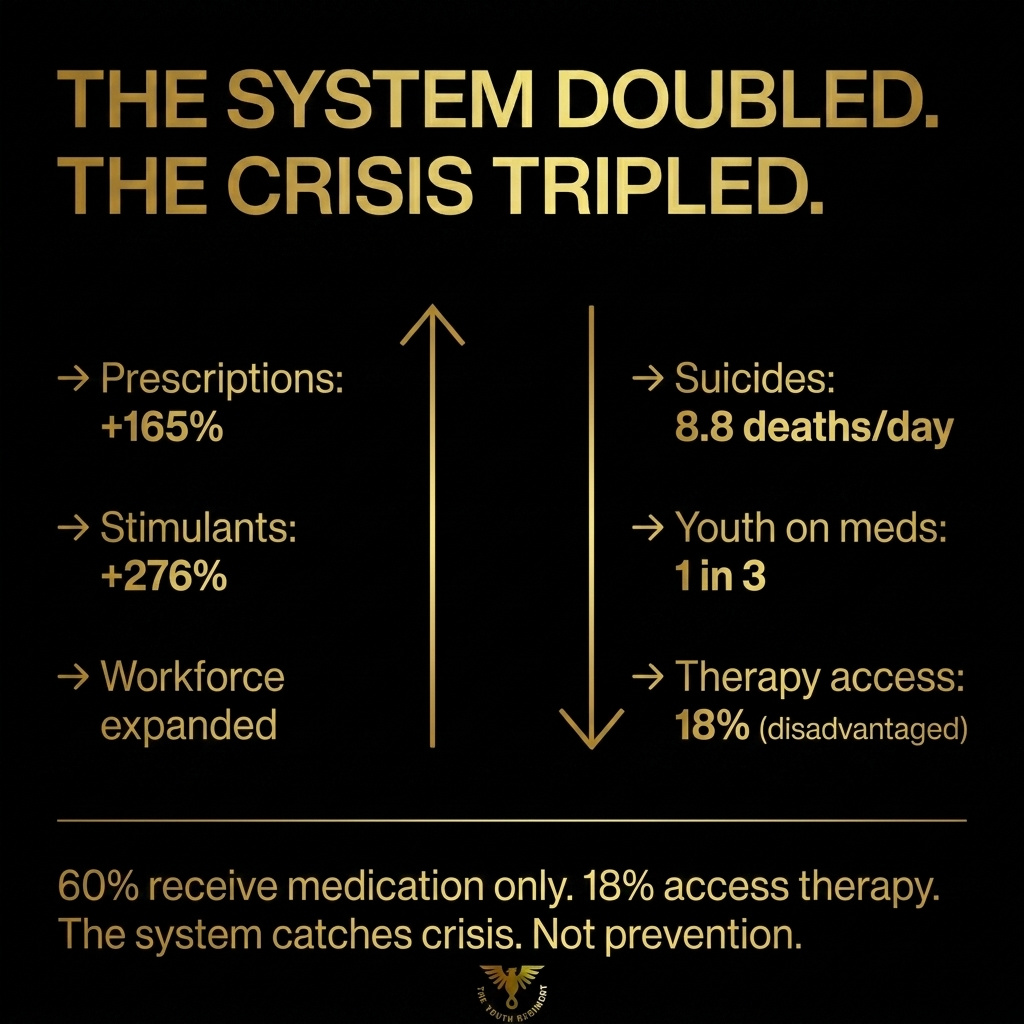
Between 2013 and 2023, psychiatric prescriptions to children under 18 more than doubled. Stimulant medications almost quadrupled, from 101 per 1,000 children in 2013 to 380 per 1,000 in 2023. Antidepressants prescribed to children increased by 165 per cent. By age 20, one in three young Australians has been prescribed a mental health medication.
Australia now prescribes stimulants to children at seven times the rate of Denmark. One in ten Australian children is on two or more psychiatric medications simultaneously.
Researchers at the University of New South Wales found no evidence that the mental health of young Australians is worse than comparable countries. The reason for the higher prescribing rates is structural. Shorter consultations are better remunerated than longer therapeutic sessions. Psychosocial support is unavailable or unaffordable. Child psychiatrists report daily pressure to prescribe because the alternatives do not exist for most families.
The medication fills the gap left by the system.
Suicide
In 2007, the age-standardised suicide rate was approximately 10.6 per 100,000 people. That translated to around 5.2 deaths per day.
By 2023, the rate had risen to 11.8 per 100,000. Deaths per day: 8.8. Total deaths: 3,214. That is 69 per cent more Australians dying by suicide each year in raw numbers.
Males account for 75.3 per cent of all suicide deaths, at a rate of 18.0 per 100,000. In remote and very remote areas, that rate more than doubles to 32.9 per 100,000, compared to 14.9 in major cities.
Aboriginal and Torres Strait Islander peoples die by suicide at a rate of 30.2 per 100,000. More than double the non-Indigenous rate. The median age of death is 33 years.
Of all suicide deaths in 2023, 83.3 per cent involved at least one identifiable risk factor. The average was four. Mood disorders appeared in 37.5 per cent of cases. Relationship problems in 23.7 per cent. History of self-harm in 21.3 per cent.
These are not random tragedies. They are predictable. Many are preventable.
Domestic and Family Violence
In 2007, the sexual assault victimisation rate was 95.8 per 100,000 people. By 2024, it had risen to 147.4 per 100,000. A 54 per cent increase over 17 years. Total victims in 2024: 40,087. The highest number ever recorded in the ABS time series.
New South Wales recorded 13 consecutive annual increases in sexual assault victim numbers.
In 2024, 175 people were killed in family and domestic violence incidents, accounting for 39 per cent of all homicides in Australia. A further 16,281 sexual assaults, or 41 per cent of all sexual assaults recorded nationally, were family and domestic violence related.
The proportion of all assaults that are family and domestic violence related now sits at 65 per cent in Western Australia, 60 per cent in Queensland, and 49 per cent in New South Wales.
Female victims of family and domestic violence homicide are most commonly aged between 35 and 54. The violence is concentrated in the home, in the years when families are most likely to include children.
Housing Instability and Mental Health
People with a mental health condition are 2.5 times more likely to have experienced homelessness than people without one. Among Australians aged 25 to 44, lifetime homelessness rates sit between 32 and 33 per cent for those with a mental health condition, compared to 13 per cent for those without.
Social housing tenants are prescribed mental health medications at a rate of 26 per cent. In private rentals, that rate is 8 per cent.
In the most disadvantaged areas, 60 per cent of people with mental health conditions receive medication-only treatment. Only 18 per cent access therapy. In remote areas, 67 per cent receive medication only. In major cities, 49 per cent.
The pattern holds regardless of where you look. The people with the greatest need receive the least therapeutic support.
The Workforce That Grew Without Fixing the Problem
In 2006, there were 3,258 psychiatrists working in Australia, at a rate of 18 FTE per 100,000 population. Approximately 90 per cent worked in major cities, leaving regional and remote areas with rates as low as 4 per 100,000.
By 2023, the total number of psychiatrists had grown to 4,300. Mental health nurses reached 25,000. Psychologists reached 33,000. Mental health occupational therapists: 2,800. Accredited mental health social workers: 2,900. The number of peer workers grew by an average of 18 per cent per year between 2017–18 and 2021–22.
The specialist mental health workforce — psychiatrists, nurses and psychologists combined — grew by approximately 88 per cent between 2007 and 2022. And yet NSW still has just one psychiatrist per 100,000 population in outer regional areas. Country South Australia has one psychiatrist per 100,000. The Murrumbidgee region has three. Brisbane's inner city has 27.
The workforce grew. The distribution did not change. The people who most needed care remained the least likely to receive it.
Psychiatrist consultation numbers reflect this directly. In major cities, people who saw a psychiatrist averaged 7.4 consultations per year. In remote and very remote areas, the average was 4.0. A 46 per cent gap in depth of care for the people who need it most.
The Medicare Benefits Schedule compounds this further. Shorter consultations attract higher rebates relative to time than longer therapeutic sessions. The financial structure of the system rewards prescribing over sustained therapeutic engagement. This is not a failing of individual clinicians. It is a design flaw built into the funding model.
The System Grew. The Outcomes Did Not.
Spending grew. Facilities grew. The workforce grew by 88 per cent. Consultation rates grew. New programmes launched. New strategies were written.
The suicide rate increased. Domestic and family violence increased. Children's psychiatric prescriptions more than doubled. The proportion of people with severe mental illness who accessed professional help barely moved. The geographic and socioeconomic gaps in access remained.
The system is not broken because it lacks resources. It is broken because the resources are directed toward crisis response and toward people who are already relatively advantaged, rather than toward prevention and toward the people who need it most.
Medication has a role. For some people, it is essential. But when 60 per cent of people in disadvantaged areas receive medication only, and only 18 per cent access therapy, the system is not providing treatment. It is providing containment.
When the Better Access programme spends $29 million a week and the access rate for people with severe disorders does not shift, the question is not whether we are spending enough. The question is whether we are spending it in the right places, on the right people, at the right time.
Early Intervention Is Not Optional
The data shows where the system fails. It fails at the point of first contact. It fails when a child is suspended from school for the first time. It fails when a family reaches out for help and receives a prescription instead of a plan.
Early intervention is not a luxury. It is the only approach that addresses the problem before it becomes entrenched.
After eight years working with more than 3,500 families across Australia, the same pattern repeats in every state, every postcode, every demographic. Parents arrive broken. They have been asking for help for years. Their children have been suspended from school seven, eight, nine times. They have seen doctors, clinical psychologists, psychiatrists, counsellors. In many cases, the children are on multiple medications. The situation got worse, not better.
These families are not outliers. They are the norm for anyone who falls outside the narrow band of people who can afford private therapy, who live in areas with available services, who have the social capital to navigate the system.
What Needs to Happen
The solution is not more of the same. It is not more prescriptions. It is not more crisis beds. It is not more youth detention centres. It is not more reports.
The solution is structural change at the point of first contact, and a funding model that rewards early intervention rather than crisis response.
In schools: Implement early intervention protocols after the first suspension. Work with families to provide support and education on mental resilience, not just academic performance. Catch the problem early.
In the mental health system: Prioritise psychosocial support over medication for children and families who can benefit from it. Change the funding structure so therapy is as accessible as a prescription. Direct the Better Access programme toward people with moderate and severe disorders, not repeat low-need clients.
In housing policy: Recognise that housing instability and mental health are inseparable. Stable housing is not a reward for recovery. It is a precondition for recovery.
In youth justice: Stop treating youth crime as a law enforcement problem. Treat it as a mental health and education problem. Invest in community-based programmes that address root causes.
The Data Is Clear
The system grew. The outcomes did not improve in proportion.
The people with the greatest need receive the least therapeutic support. They get scripts, not sessions.
The resources flowed toward the worried well. The severely unwell were left behind.
Investment in early intervention and community-based psychosocial support is the gap the data points to. Not theoretically. Measurably. Documentably. The evidence is not ambiguous.
The question is whether we have the will to act on it.
Sources
Australian Bureau of Statistics, Causes of Death 2023 (released October 2024); ABS Recorded Crime – Victims 2024 (released September 2025); ABS Mental Health and Experiences of Homelessness 2014; ABS Housing Circumstances of People Using Mental Health Services 2011; ABS Patterns of Use of Mental Health Services and Prescription Medications 2011; Australian Institute of Health and Welfare, Mental Health Services in Australia – Workforce 2021; AIHW Mental Health Expenditure Data 2022–23; Harris et al., Consultation with health professionals for mental health in Australia in 2020–2022 and changes since 2007, Australian and New Zealand Journal of Psychiatry (2025); Stephenson, Karanges and McGregor, Trends in the utilisation of psychotropic medications in Australia from 2000 to 2011, Australian and New Zealand Journal of Psychiatry (2013); ABC News, Antidepressants, antipsychotics and stimulants up: Why are children taking more mental health medications? (September 2024); Medical Republic, One in three Aussie youths on mental health drugs (January 2025); Health Services Daily, Psychiatry deserts exposed as expenditure climbs (February 2025); Everymind / Life in Mind, National Suicide Data Summary 2023 (October 2024).