We're Funding the Wrong Mental Health System: Why 20% Reallocation Would Save a Generation
We're Funding the Wrong Mental Health System: Why 20% Reallocation Would Save a Generation
I've spent 10 years on the frontline of Australia's youth mental health crisis. Thousands of contact hours. Children expelled seven, eight, nine times from school. Kids who've cycled through psychiatrists, psychologists, and counselors for years.
And I've watched the system make them worse.
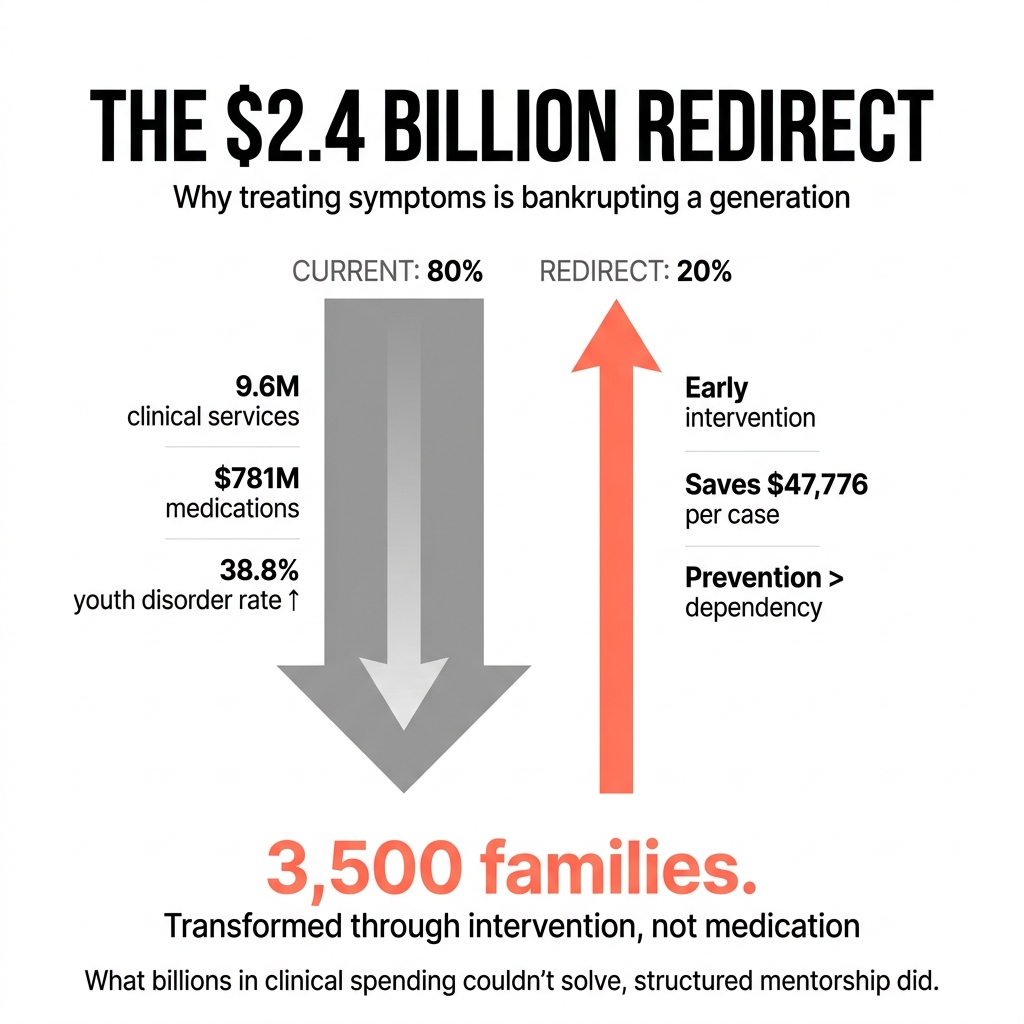
Not because the professionals don't care. They do. But because we're pouring billions into a model that treats symptoms while the underlying crisis accelerates. Mental health-related PBS prescriptions increased from $741 million in 2019-20 to $781 million in 2024-25. More medication. More clinical services. Worse outcomes.
Here's what needs to happen: Take 20% of federal and state mental health funding out of the medical system, the clinical allied health system, and the pharmaceutical scheme. Put it into early intervention, youth development, and proper mentorship.
Not as an addition. As a reallocation.
The Current System is Creating Dependency, Not Solutions
The numbers tell a brutal story.
38.8% of Australians aged 16-24 have a 12-month mental disorder. They're twice as vulnerable as the general population. Nearly half of young Australians experience high or very high levels of psychological distress. 98% reported feelings of anxiety or depression at least once in the past year.
We've responded by scaling up the exact interventions that coincided with this crisis.
In 2024-25, we delivered 9.6 million Medicare-subsidized mental health services. Psychologists provided 6.2 million. Psychiatrists another 2.8 million. Allied health professionals added 600,000 more.
Yet the crisis continues to worsen.
I see this pattern every program. A 14-year-old arrives. They've been seeing a psychologist for two years. They're on medication for anxiety and depression. They've had ten free counseling sessions. Their parents are broken, isolated, screaming for help.
The clinical system offered them a pathway: diagnose, medicate, counsel, repeat.
What they needed was someone to teach them resilience. To get them moving their body. To remove the tech addiction destroying their self-esteem. To show them they're capable of hard things.
The medical model creates patients. We need to create capable humans.
Early Intervention Works—And It's Cheaper
The economic case for reallocation is proven.
Research shows that four months of early intervention using a patient-centered, trauma-informed model costs $1,634. Without it, psychiatric evaluation alone costs $2,188. Functional family therapy produces savings of $47,776. Multi-systemic therapy saves $17,694.
Early intervention is more responsive. More cost-effective. More successful.
But it's chronically underfunded because we've built an entire infrastructure around late-stage clinical intervention.
I've watched this play out hundreds of times. A child gets suspended from school once. That's the moment. That's when you intervene with mentorship, structure, and proper guidance. Instead, we wait. Another suspension. Another. By the time they reach us, they've been expelled, they're on multiple medications, and they've lost years to a system that pathologized struggle instead of building capacity.
Prevention and early intervention produce the greatest impact on health and wellbeing. The research confirms it. My frontline experience proves it.
Yet we keep funding the back end.
What 20% Reallocation Would Actually Look Like
Imagine this system:
A doctor sees a 13-year-old struggling with anxiety. Before prescribing medication or referring to a psychologist, they have a third option: a funded mentorship program. Structured. Evidence-based. Delivered by people who've overcome adversity themselves.
The program is funded exactly like the pharmaceutical scheme. It's accessible. It's legitimate. It's integrated into the care pathway.
The child spends ten days learning resilience, physical discipline, and mental toughness. They disconnect from technology. They learn to be uncomfortable. They discover they're capable of more than they believed.
Their parents receive guidance. Not a workshop on managing symptoms, but actual tools to rebuild the family structure.
This isn't theoretical. I've run this model for eight years. The results are undeniable. Families who've been lost in the mainstream system for years find solutions in days.
Now scale it. Take 20% of the billions we're spending on clinical services and pharmaceutical interventions. Build a parallel system focused on prevention, development, and early intervention.
Fund it properly. Train mentors. Integrate it with schools. Give doctors the option to prescribe mentorship before medication.
The NSW Data Already Shows We're Going the Wrong Direction
The NSW Youth 2027-2030 policy statistics reveal the pattern clearly: the more we invest in psychology, psychiatrists, and accessible medication, the worse the problem becomes.
This isn't because clinical professionals are failing. It's because we're asking them to solve a problem that requires a fundamentally different approach.
You can't counsel your way out of tech addiction. You can't medicate away the absence of physical discipline and mental resilience. You can't psychologize a solution to a structural problem.
I've seen children on three, four, five different medications. Their parents have spent years in the system. Thousands of dollars. Countless hours. And when they arrive at our program, the first thing we do is get them off screens, get them moving, and teach them they're stronger than they think.
Within days, the transformation begins.
Not because we're better than psychologists. But because we're addressing different needs with different tools.
The GDP Argument Nobody's Making
Here's what happens when you solve youth mental health properly:
You create a generation of capable, resilient adults. They work. They contribute. They don't cycle through disability support and clinical services for decades.
The economic multiplier is massive.
Every child we pull out of the clinical pathway early becomes a productive member of society. They don't cost the healthcare system hundreds of thousands over a lifetime. They add value.
Over a ten-year period, if we implemented this reallocation tomorrow, you'd see GDP skyrocket.
Not because of some abstract economic theory. Because you'd have hundreds of thousands of young Australians who learned resilience instead of dependence. Who built capacity instead of identifying as patients.
The current system creates lifetime consumers of mental health services. We need to create one-time participants in development programs.
This Requires Political Courage
I've given testimony to the Youth Justice Reform Select Committee in Queensland. I've delivered keynote addresses to premiers and police commissioners. I've worked with Senator Jacqui Lambie to push for social media age restrictions.
The political will exists to acknowledge the crisis.
What's missing is the courage to reallocate funding away from entrenched systems.
The medical establishment won't support this. The pharmaceutical industry won't champion it. The clinical psychology sector won't advocate for their own funding reduction.
But parents will. Because they've lived the failure of the current system.
And the data supports it. And the economics justify it. And the frontline evidence proves it.
Twenty percent reallocation. Not twenty percent more funding to mental health overall. Twenty percent moved from clinical and pharmaceutical interventions to early intervention and youth development.
Fund mentorship programs like we fund medication. Give doctors the option to prescribe resilience training before antidepressants. Integrate youth development into the healthcare pathway with the same legitimacy as psychiatric referrals.
The System We Need Already Exists—It Just Needs Funding
I've built this model. It works. The Youth Regiment is designed specifically for early intervention through schools, the mental health system, youth justice, and law enforcement.
We catch children after their first suspension, not their seventh expulsion. We work with families before they're broken, not after years of failed interventions. We provide post-program support that continues the development instead of sending them back into the same environment that created the crisis.
This model exists. The evidence exists. The demand exists.
What's missing is the structural reallocation of funding to make it accessible at scale.
Australia is investing $12 billion annually in mental health. Twenty percent of that is $2.4 billion. Redirected into early intervention, youth development, and proper mentorship, that funding would transform the landscape.
Not in theory. In practice.
I've seen it work with over 3,500 families. I've watched children who were written off by the system discover they're capable of extraordinary things. I've seen parents who felt isolated and hopeless find community and solutions.
The question isn't whether this approach works. The question is whether we have the courage to fund it properly.
Because the current system is failing. The statistics prove it. The families living it know it. And the billions we're spending are making the problem worse, not better.
Twenty percent reallocation. Early intervention. Youth development. Proper mentorship.
That's how we save a generation.