Submission to the NSW Office for Youth: Strategic Plan for Children and Young People 2027–2030
Submission to the NSW Office for Youth: Strategic Plan for Children and Young People 2027–2030
Submitted to: NSW Office for Youth, Department of Communities and Justice
Submitted by: Matthew French, CEO and Founder, The Youth Regiment
Date: June 2026
Submission type: Individual expert submission — practitioner with documented frontline evidence
Contact: The Youth Regiment | Sydney, NSW
Executive Summary
This submission responds to the NSW Office for Youth Consultation Paper for the NSW Strategic Plan for Children and Young People 2027–2030, published April 2026.
I am Matthew French, CEO and Founder of The Youth Regiment, and previously co-founder of Veteran Mentors. I have spent eight years on the frontline of Australia's youth crisis, working directly with more than 3,500 families across every state and territory. I have delivered testimony as an expert witness to the Youth Justice Reform Select Committee in Queensland. I have presented at the Retail Crime Symposium 2024 alongside Senator Jacqui Lambie, before the Victorian Premier, the Police Commissioner, and the CEOs of Bunnings, Woolworths, and Coles. I work alongside Dr Xanthe Mallett, one of Australia's leading criminologists, who is starting a independent peer review of our program outcomes.
This submission identifies three systemic failures driving the youth crisis in NSW, presents documented evidence from both the consultation paper and national data, and makes three specific, actionable recommendations for the 2027–2030 Strategic Plan.
The three failures are:
The over-medication of young Australians in place of structured mentorship and early intervention
The use of school suspension as a default response, which functions as systemic abandonment rather than behaviour management
The collapse of community engagement and the absence of trusted adult relationships for young people at risk
The Youth Regiment has developed a proven, peer-reviewed, replicable model that addresses all three failures simultaneously. This submission asks the NSW Government to formally engage The Youth Regiment as a delivery partner in the implementation of the 2027–2030 Strategic Plan.
About The Youth Regiment & Matthew French
The Youth Regiment is an Australian-first youth development organisation founded in 2025, building on eight years of documented results through Veteran Mentors (founded 2016). Our flagship program, Fortified Futures, is a 216-hour (nine-day) immersive, veteran-led intervention that operates across three levels simultaneously: the young person, the family, and the community.
My Key credentials:
More than 3,500 families worked with across Australia since 2016
$500,000 secured in investment at launch in 2025
Peer review is currently in the early stages by Dr Xanthe Mallett, criminologist and Director of the Justice Clinic
Collaboration with NSW Police Force Youth Command
Partnerships with Bonnyrigg High School, Granville Boys High School, Campsie RSL Group, Learning for Good, Pro Patria, and Frontline Labs
Prime Minister's Veteran Employment Awards — two categories, 2024
Expert witness testimony, Youth Justice Reform Select Committee, Queensland
Endorsed by Senator Jacqui Lambie on the floor of the Australian Senate
Head Teacher of Wellbeing, Bonnyrigg High School: confirmed the program is an effective early intervention for youth detention
Granville Boys High School, Term 4: 100% elimination of suspensions
Program differentiators:
216-hour proof point — the longest immersive program of its kind in Australia
1:4 mentor-to-participant ratio (one veteran mentor per four young people)
Full device detox for the duration of the program
Parallel parent program — equipping families to sustain change at home
Post-program support maintained for years, not weeks
Triple impact: young people (resilience, identity, behaviour), veterans (employment and purpose), families (tools and community)
Section 1: The Over-Medication Crisis
What the Data Confirms
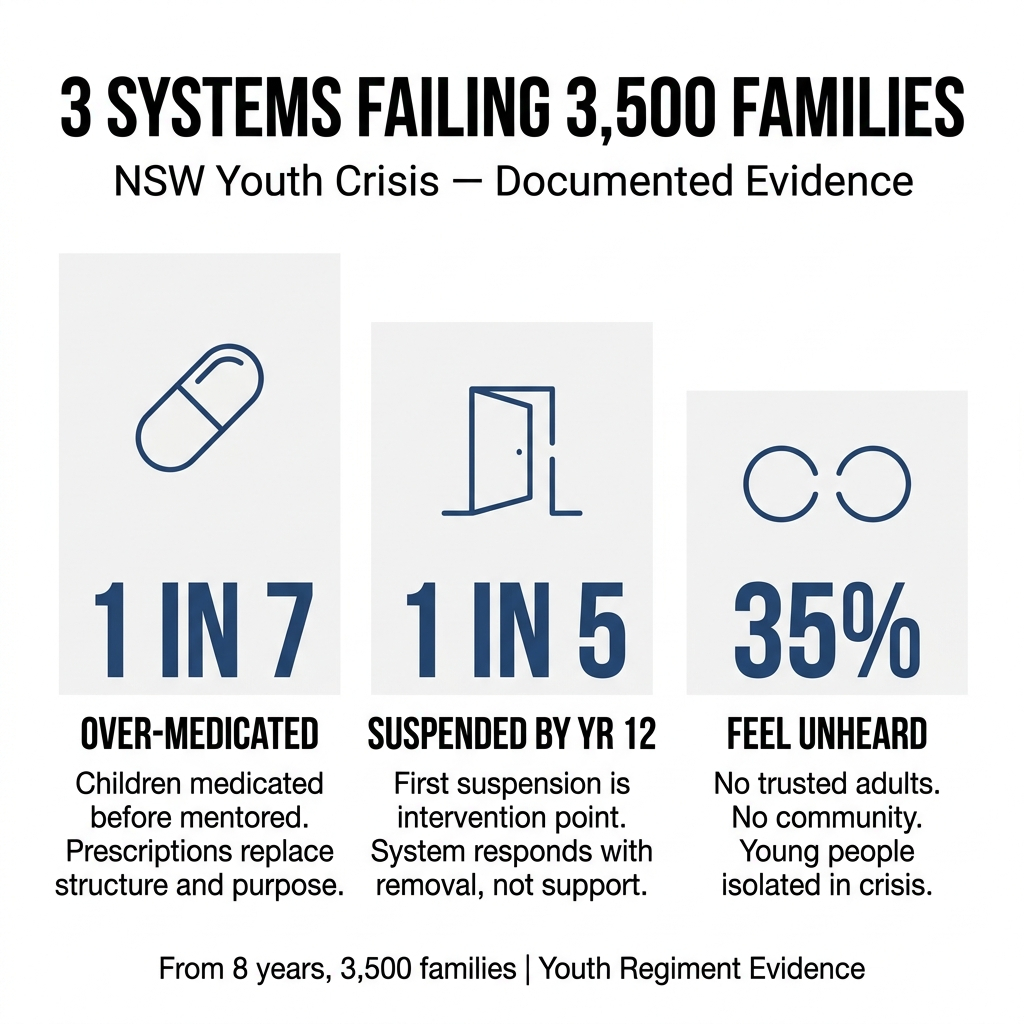
The consultation paper acknowledges that approximately one in seven children and young people aged 4 to 17 experience a mental health condition. It acknowledges that 30% of mental-health-related Emergency Department visits in NSW are by people under 25. It acknowledges that wait times for mental health services are increasing, with many young people waiting more than a month. It acknowledges that the 10-session Medicare cap on psychological services is a major barrier identified directly by young people themselves.
The 2025 National Youth Survey, conducted by the Australian Government's Office for Youth across 2,333 young Australians, confirms that mental health is the second most important issue for young people nationally, cited by 28% of respondents — second only to cost of living at 47%.
Students' sense of belonging at school has been declining in both primary and secondary schools since 2017. Two in five students rate their school stress as high. Young people cite bullying — both in person and online — as a major cause of distress. The consultation paper confirms that 74% of young people have seen harmful online content, 53% have experienced cyberbullying, and three in five have witnessed online hate.
Suicide is the leading cause of death for young people aged 15 to 24 in NSW.
These statistics do not exist in isolation. They represent the downstream consequences of a system that has defaulted to clinical and pharmaceutical responses while failing to invest in the upstream conditions — mentorship, structure, belonging, and purpose — that build genuine mental resilience.
What Eight Years on the Frontline Confirms
The children who have come through our programs arrive carrying diagnoses and prescriptions. ADHD. Anxiety. Depression. Oppositional defiant disorder. Conduct disorder. Many are on multiple medications simultaneously — antidepressants, antipsychotics, stimulants, mood stabilisers.
Dr Xanthe Mallett, who conducts independent peer review of our outcomes, stated this directly: "In Matt's words, these children came to us with an empty toolbox and only know counselling and medication. The amount of medication those children are on is absolutely mind-blowing."
Senator Jacqui Lambie, who mentored on my 40th program and subsequently advocated for our work on the floor of the Australian Senate, stated: "The medication they are on is heavily reduced or they are taken off it post program."
This is not anecdotal. This is a pattern documented across thousands of participants, confirmed by a leading criminologist, and placed on the parliamentary record.
The pattern is consistent: a child struggles at school. The school refers to a GP. The GP refers to a psychologist. The psychologist refers to a psychiatrist. The psychiatrist prescribes medication. The medication does not resolve the underlying condition. The dose is adjusted. A second medication is added. The child deteriorates further. The parents are told this is the only available pathway.
It is not.
What our program provides structure, physical training, routine, vulnerability, connection, mentorship, and purpose — addresses the conditions that medication cannot reach. When children are given these tools, their clinical presentations frequently improve. The medication becomes less necessary. In many cases, under their doctor's guidance, it is ceased entirely.
We are not anti-medication. Medication has a role. But it should not be the first response to a struggling young person. It should not replace the mentorship, structure, and community that build genuine resilience. And it should not be prescribed in the absence of a parallel investment in the conditions that make young people well.
Recommendation 1
The NSW Strategic Plan 2027–2030 should establish a formal pathway for community-led mentorship programs to be integrated alongside — not after — clinical mental health responses for young people aged 10 to 17.
Specifically: where a young person is referred for psychological assessment following school-based behavioural concerns, a structured mentorship program should be recommended concurrently. Medication review should be included as a standard component of any post-program assessment. Programs meeting evidence standards (peer review, documented outcomes, qualified mentors) should be eligible for government commissioning as part of the mental health continuum of care.
Section 2: The School Suspension Crisis
What the Data Confirms
The consultation paper presents data that should be confronting for any government committed to equity in education. By Year 12, nearly one in five students in NSW have been suspended or expelled. Suspension rates are twice as high for Aboriginal and Torres Strait Islander students and students living with disability. They are more than three times higher for students in care.
The same data confirms that 97% of NSW schools with a high concentration of disadvantage are public schools. Most students experience school-related stress. Some students are missing more school than others — specifically students with additional needs, Aboriginal and Torres Strait Islander students, and students living in remote areas.
The consultation paper directly quotes young people on the experience of suspension: suspensions make students feel worse, often increasing loneliness, boredom, and isolation. Many suspensions feel unfair and do not address underlying needs. Schools are perceived as overly focused on HSC outcomes, with insufficient options for students whose strengths lie elsewhere.
The data on equity in higher education reinforces the trajectory. Domestic undergraduate commencements have fallen to 2013 levels. Regional students are half as likely to obtain a university degree. By 2035, nine in ten jobs are expected to require post-secondary qualifications. The pipeline from early school disengagement to long-term economic exclusion is not a hypothesis. It is a documented pattern.
The consultation paper acknowledges that the 2022–2024 Strategic Plan required improvement in targeted advocacy, clearer measurement of success, and better coordination across government. It acknowledges that the previous plan did not go far enough.
What it does not yet name clearly enough is this: suspension, as currently practised in NSW schools, is not a behaviour management tool. It is systemic abandonment.
What Eight Years on the Frontline Confirms
Every child who has come through our program has a suspension history. Seven suspensions. Eight. Nine. Some have been expelled from multiple schools. Each suspension was a signal — a signal that the child was struggling, that the environment was failing them, that intervention was needed.
Each suspension was met with the same response: send them home. Tell the parents to manage it. Wash the system's hands of the problem.
The child fell further behind. The child became more isolated. The child lost more self-esteem. The cycle accelerated. The next suspension came faster.
The first suspension is the intervention point. Not the tenth. Not the expulsion. The first suspension is the moment the system should respond with support, not removal.
Our pilot strategy is explicit: "Using educators to target children early before they are suspended 10 times." We enter schools at the point of first concern. We work with teachers and wellbeing staff to identify students at risk. We deliver structured modules on mental resilience and goal-setting. We work with the student and the family simultaneously.
At Granville Boys High School, we worked with Year 8 and Year 9 students identified as at risk. The program ran across eight weeks. Term 4 suspensions: zero. Reduction: 100% elimination.
At Bonnyrigg High School, in collaboration with NSW Police Force Youth Command, the Head Teacher of Wellbeing confirmed our program is an effective early intervention initiative for youth detention. Not just for school behaviour. For youth detention.
The research is unambiguous. Every dollar spent on early intervention saves ten in later incarceration, healthcare, and social services. Catching kids early saves families, saves money, and saves lives.
The 2027–2030 Strategic Plan has an opportunity to embed this principle structurally. The window to do so is now.
Recommendation 2
The NSW Strategic Plan 2027–2030 should establish a formal early intervention trigger at the point of a student's first suspension, requiring schools to commission a structured, community-led intervention program within 30 days.
Specifically: schools should be resourced and required to engage accredited early intervention providers — including veteran-led and community-led programs — at the point of first suspension rather than as a last resort. Programs should operate across both the student and the family unit. Outcomes should be tracked and reported against the NSW Performance and Wellbeing Framework. Aboriginal and Torres Strait Islander students and students in care, who face suspension rates two to three times higher than their peers, should be prioritised for immediate rollout.
Section 3: The Community Engagement Collapse
What the Data Confirms
The 2025 National Youth Survey found that 98% of young Australians believe it is important for the government to consider their views when making decisions. Only 35% feel that it does. The gap between what young people need from their institutions and what those institutions deliver is not marginal. It is a 63-percentage-point chasm.
The top barriers preventing young people from engaging with government are: not knowing how to (39%), not having enough time (34%), and not believing they will be listened to (33%). Young people in Greater Sydney stated directly: "The government consistently deprioritises the things young people call for." Young people in regional NSW stated: "Living in regional NSW, I feel young voice is lost in governance."
The consultation paper confirms that students' sense of belonging at school has been declining since 2017. It confirms that young people who feel part of a community are less likely to feel long-term loneliness. It confirms that youth hubs function as preventive social infrastructure, reducing disengagement, justice involvement, and long-term social cost. It confirms that one in three women under 25 feel unsafe in public spaces after dark.
It confirms that 1 in 2 people accessing homelessness services in NSW are under 25. That Aboriginal children are 10 times more likely to be in out-of-home care. That foster carer numbers decreased by 13% between 2021 and 2024. That caseworker capacity is not meeting demand.
The consultation paper quotes a young person with youth justice experience: "The issue young people in the justice system face is that even through all the interventions and supports young people receive in custody, a majority will be exited into the same situations they were in before custody."
Another stated: "One day you are released back into the real world, and most young people don't have the tools to deal with the stress and discomforts they once experienced prior to entering custody."
These are not policy failures. They are community failures. And they are failures of connection.
What Eight Years on the Frontline Confirms
The children who come to our program are not just struggling behaviourally. They are isolated. They have no trusted adults outside their immediate family. In many cases, they have no trusted adults at all. They spend 10 to 12 hours a day on devices. They have been bullied online. They have no physical community — no sports team, no youth group, no mentor, no role model who looks like someone who has been through adversity and survived it.
The parents are equally isolated. They feel they are the only family struggling. They feel they have failed. They have been turned away from services, put on waiting lists, and told to manage.
The consultation paper identifies trusted relationships with adults as an important protective factor. It is not merely a protective factor. It is the central mechanism through which resilience is built. Without a trusted adult who stays — who does not abandon the young person when things get hard, who does not hand the case to someone else, who shows up on the hard nights — no amount of clinical intervention or policy architecture will hold.
Our 1:4 mentor-to-participant ratio exists precisely because of this. One veteran mentor for every four young people. That mentor is not a counsellor. They are not a caseworker. They are someone who has been through their own version of the struggle — combat, trauma, loss, rebuilding — and come out the other side. They model what it looks like to face the worst and keep going.
On night two of our program, around a campfire, I tell my own story. I tell the children about Afghanistan. About losing mates. About breaking my neck. About the medication. About the despair. I let them see me cry. I let them see me be vulnerable. Because a lot of these children have never seen a man do that. They have never seen an adult admit they struggled and survived.
And then the children tell their stories. And the room changes.
That is not something a policy document can manufacture. But it is something a government can fund, scale, and protect.
Recommendation 3
The NSW Strategic Plan 2027–2030 should formally recognise veteran-led and community-led mentorship programs as a pillar of youth preventive social infrastructure, with dedicated funding and commissioning pathways equivalent to those available to clinical mental health services.
Specifically: veteran-led mentorship programs meeting evidence standards should be eligible for long-term government commissioning contracts — not one-off grants, not pilot funding, not charity status — but sustained investment as core infrastructure. The NSW Government should establish a formal partnership framework with The Youth Regiment to deliver school-based early intervention modules, post-suspension intensive programs, and community re-engagement support for young people exiting the youth justice system.
Section 4: Why Matthew French CEO The Youth Regiment Is the Right Partner
The NSW Strategic Plan 2027–2030 consultation paper identifies five themes: Educated and Thriving, Community Connection, Supported and Safe, Healthy and Well, and Voice and Influence. The Youth Regiment's model addresses all five.
Strategic Theme Youth Regiment Response Educated and Thriving School-based early intervention modules before first suspension. Post-suspension structured programs. Goal setting, mental resilience, and entrepreneurship training embedded in all programs. Community Connection Nine-day immersive program builds genuine peer and mentor bonds. Post-program community maintained for years. Parent program builds a parallel community of families. Triple impact model employs veterans and rebuilds their sense of purpose and belonging. Supported and Safe Program explicitly designed for young people exiting or at risk of entering youth justice, out-of-home care, and homelessness pathways. Collaboration with NSW Police Force Youth Command. Family support sustained post-program. Healthy and Well Physical training, device detox, routine, nutrition, and sleep embedded in program structure. Documented reduction in medication post-program. Vulnerability and emotional expression modelled by veteran mentors. 1:4 mentor-to-participant ratio ensures no young person is lost in a group. Voice and Influence Young people are heard, respected, and given agency throughout the program. Post-program alumni become junior mentors — turning participants into leaders. The program structure ensures every voice is heard around the campfire, in small groups, and in one-on-one mentor conversations.
The Youth Regiment is not a new idea seeking pilot funding. It is a proven model with documented outcomes, independent peer review, government endorsement at the Senate level, school-level validation, and $500,000 in private investment already secured.
We have the infrastructure. We have the team. We have the track record. We have the partnerships and collaborations with schools, with police, with allied health, with NRL, with RSL, Safelink.Alliance and with the Senate.
What we need from the NSW Government is not charity. It is recognition, commissioning, and a formal seat at the table where the 2027–2030 plan is implemented.
Section 5: Summary of Recommendations
#RecommendationStrategic Theme Urgency 1 Establish formal pathways for community-led mentorship programs to be integrated alongside clinical mental health responses for young people aged 10–17. Include medication review as a standard post-program assessment component. Commission programs meeting evidence standards as part of the mental health continuum of care. Healthy and Well Critical 2 Establish a formal early intervention trigger at the point of a student's first suspension, requiring schools to commission a structured, community-led intervention within 30 days. Prioritise Aboriginal and Torres Strait Islander students and students in care. Track outcomes against the NSW Performance and Wellbeing Framework. Educated and Thriving Critical 3 Formally recognise veteran-led and community-led mentorship programs as a pillar of youth preventive social infrastructure. Establish sustained commissioning contracts — not one-off grants. Develop a formal partnership framework with The Youth Regiment for school-based, post-suspension, and youth justice re-entry programs across NSW. Community Connection / Supported and Safe Critical
Closing Statement
The NSW Strategic Plan for Children and Young People 2027–2030 arrives at a moment of documented crisis. Suicide is the leading cause of death for young people aged 15 to 24. One in two people accessing homelessness services in NSW are under 25. Nearly one in five students will be suspended or expelled before Year 12. Only 35% of young Australians feel the government considers their views. Mental health disorder cases have nearly doubled globally since 1990, with 1.2 billion people now living with a mental health condition worldwide.
The previous strategic plan acknowledged it could do better. The new plan has an opportunity to do so. But only if it moves beyond coordination frameworks and consultation papers into direct commissioning of the models that are already working on the ground.
The Youth Regiment is one of those models. We have the evidence. We have the peer review. We have the Senate endorsement. We have the school results. We have the families who say, without reservation, that our program saved their children.
A Parent, whose son attended two of our programs, wrote this: "Craig Love, Campsie RSL, Matthew French and Veteran Mentors — we love you, we are forever grateful for you, and you saved our son and family."
A parent who attended wrote: "I hope that the government considers funding this amazing initiative and that it is available to all our children."
Senator Lambie said on the Senate floor: "The government needs us. We don't need the government."
She is right. The Youth Regiment will continue this work regardless. We will continue to show up for families that the system has abandoned. We will continue to run programs that the data says work. We will continue to employ veterans and give them purpose. We will continue to build the community that these children have never had.
But the scale of this crisis demands more than what any single organisation can deliver alone. It demands government partnership. It demands sustained investment. It demands the courage to commission what works rather than fund what is familiar.
The 2027–2030 Strategic Plan has that opportunity. I am asking the NSW Government to take it.
I am available to present in person to the Office for Youth, the NSW Youth Advisory Council, or any relevant government committee at the earliest opportunity.
Matthew French - Nomination for Australian of the year 2024
CEO and Founder, The Youth Regiment
Former Co-Founder, Veteran Mentors
Expert Witness, Youth Justice Reform Select Committee, Queensland
Prime Minister's Veteran Employment Awards Recipient, 2024
Sydney, NSW, Australia
June 2026
References
All statistical claims in this submission are sourced from the following government documents:
NSW Office for Youth (April 2026). Consultation Paper: NSW Strategic Plan for Children and Young People 2027–2030. NSW Department of Communities and Justice.
Australian Government, Office for Youth (2025). 2025 National Youth Survey Summary Report. Canberra: Australian Government.
Australian Institute of Health and Welfare (2025). Prevalence and impact of mental illness. AIHW website.
NSW Bureau of Crime Statistics and Research (2025). NSW Recorded Crime Statistics quarterly update September 2025.
Homes NSW (2026). Reducing homelessness in young people. NSW Government website.
Lauren M. Piltz et al. (2025). Students' accumulation of disciplinary school exclusion experiences over time. Children and Youth Services Review, Vol. 179.
Institute for Health Metrics and Evaluation and University of Queensland (2026). Global mental disorder burden. The Lancet.