The School Suspension Crisis: How Early Intervention Could Have Saved 3,500 Families Years of Pain
The School Suspension Crisis: How Early Intervention Could Have Saved 3,500 Families Years of Pain
The data tells a story I already know by heart. 19% of 72,000 NSW studentsyes tracked over a decade were suspended or expelled at least once between Year 3 and Year 12. Almost half of all suspensions went to just 13% of students who were suspended nine times or more.
The highest number? Fifty-four suspensions.
Let that sink in. A child was removed from school fifty-four times, and the system kept doing the same thing expecting different results.
The Pipeline We Refuse to Acknowledge
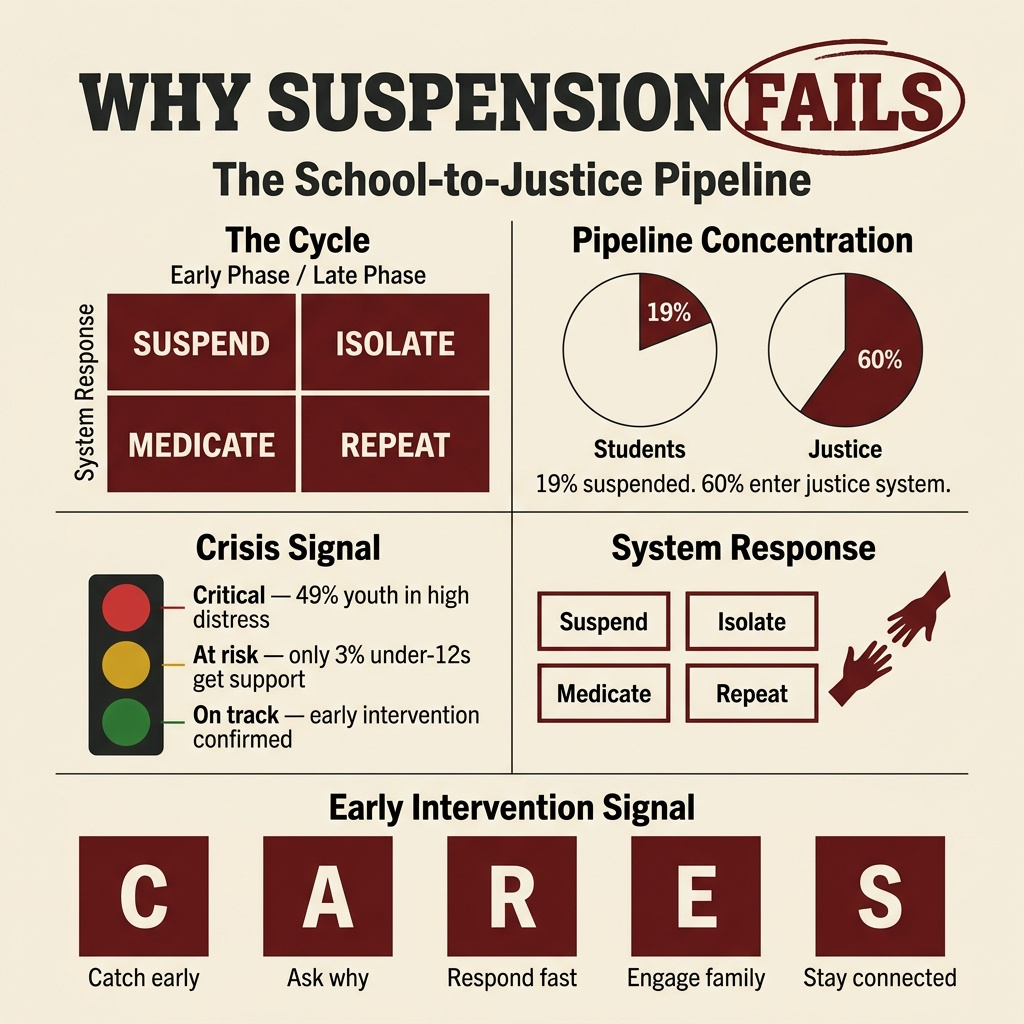
Here's what the research confirms: 60% of those in the youth justice system had previously been suspended or expelled from school.
The earlier students were suspended, the more likely they were to be suspended again. One in two students first suspended during primary school had repeat suspensions.
We're not looking at troubled teens appearing out of nowhere. We're looking at a predictable trajectory that starts in primary school and ends in the justice system.
Suspension means no adult supervision. It means association with older antisocial peers. It means falling further behind in essential skills like reading. It means a child who was already struggling now has more time, more isolation, and more reasons to believe the system has given up on them.
The Mental Health Crisis Behind the Behaviour
Every family I've worked with has a story. But the patterns are identical.
The child is struggling. The parents are screaming for help. The mainstream mental health system offers appointments six months away, medication that makes things worse, and counsellors who see the child for 50 minutes once a fortnight.
The numbers confirm what I see: 49% of young Australians are experiencing high or very high levels of psychological distress. Distress levels rise from 31% of 12–14 year-olds to 65% for those aged 18–25.
Nearly half of our young people are in crisis.
And what's the response? More referrals. More waiting lists. More medication.
I've seen children on five different medications before they turn 14. I've seen parents who've been to every specialist, every psychologist, every program the system offers. And after years of trying, the situation got worse.
Not better. Worse.
The Medication Explosion
National prescription data shows that the population rate of dispensed ADHD prescriptions increased 11-fold, from 2 patients per 1,000 population in 2004–05 to 22 patients per 1,000 population in 2023–24.
That's 2% of the entire Australian population now on ADHD medication.
I'm not anti-medication. I've been on every mental health drug and painkiller imaginable after my own battles with PTSD, anxiety, depression, and a broken neck and back. I was told by a psychiatrist I would never work again.
But I also know that medication alone doesn't fix the problem.
When I worked with these families, I had medics who were pharmacists on my team. We could conduct research and reviews on the significant onset of over-prescribed medication in our youth.
What we found was clear: medication was being used as the first line of defence instead of the last resort.
The Tech Addiction No One Wanted to Name
The eSafety Commissioner's data now confirms what I saw on every program: around one-quarter of children aged 8 to 12 are already accessing social networking platforms. Two-thirds of Australian children have at least one social media account by the time they reach their final primary education year.
Nearly 60% of parents reported concern about their teenagers' use of social media. But here's the gap: adolescents themselves rated social media outside their top ten issues of concern.
The children don't see the problem. The parents do. And the system ignored it for years.
That took years of advocacy. Years of being told I was overreacting. Years of watching families destroyed while experts debated whether tech addiction was even real.
The Cost of Waiting
The Burnet Institute found that investing between $50 million and $1 billion annually into prevention programs could prevent up to 787,000 young Australians from experiencing anxiety and depression by 2050.
The economic benefit? Up to $74 billion.
But here's what the data doesn't capture: the human cost of waiting.
I've worked with families where the child was first suspended in Year 3. By the time they came to me in Year 9, they'd been through six psychologists, three psychiatrists, multiple medications, and countless school meetings where everyone agreed something needed to change.
But nothing did.
If we'd caught that child in before high school, we could have prevented years of pain. We could have prevented the self-harm, the suicidal ideation, the complete destruction of self-esteem.
We could have prevented the family from spending years feeling isolated, lost, and confused.
What Early Intervention Actually Looks Like
Early intervention isn't a referral to another specialist. It's not a six-month wait for an appointment. It's not a 50-minute session once a fortnight.
Early intervention is catching the child after their first suspension and asking: what's actually going on here?
It's recognising that behaviour is communication. When a child acts out, they're telling you something is wrong. The question is whether you're listening.
At Veteran Mentors, we spent 18 hours a day with these children. We got to know them on a deep and personal level. We spent hours with the parents. We gained an understanding of these families so deep that no allied mental health system or program could compare.
And we saw results.
Not because we had degrees in mental health. Not because we followed a clinical model. But because we understood that healing happens through connection, not isolation.
We broke down the child, built them up, and put them through difficult situations with tools and guidance. We taught them resilience, mental toughness, and how to become comfortable with vulnerability.
We worked with the parents, too. We held parenting workshops. We created group chats that remained active years post-program. We built a national family.
The System Failures We Need to Name
Current service models including Headspace and Kids Hubs are projected to reach only 13% of the 1.25 million children and young people who experience mild or moderate mental health needs annually in Australia by 2026.
The gap is particularly severe for children under 12, with just 3% of those needing support expected to receive it through primary care hubs.
Three per cent.
This is the system we're relying on to address a crisis where suicide is the leading cause of death for Australians aged 15–24, representing 33.1% of all deaths in that age group.
This is the system that's supposed to help when one in three teens has thought about suicide.
It's not working.
The Role of Schools in Early Intervention
Schools are the frontline. They're where we first see the warning signs. They're where we have the opportunity to intervene before a child spirals.
But instead of intervention, we have suspension. Instead of support, we have removal. Instead of asking what's wrong, we punish the symptom and ignore the cause.
The Youth Regiment will change this. We'll enter schools and provide support and education on things not taught: mental resilience, entrepreneurship, and practical life skills.
We'll work with educators to catch children early after their first suspension. Not the ninth. The first.
We'll work with allied health professionals to implement strategies based on the doctor's discretion to suggest our program before a child enters a lifetime of counselling and medication.
And we'll work with policymakers to better inform them on the direction we need to take in youth justice, education, and mental health for teenagers.
The Families Who Prove It Works
I've stayed in contact with most families years post-program. I've watched children who were expelled from school go on to complete their education. I've watched parents who felt broken and isolated rebuild their relationships with their children.
I've watched families who were told there was no hope find a way forward.
This isn't theory. This is 3,500 families over eight years. This is contact hours that no research study can replicate. This is real-world evidence that early intervention works when it's done properly.
The Investment We Need to Make
The Prime Minister has promised $1 billion in mental health investment if re-elected. Senator Lambie and I are lobbying for some of that funding to be used in this space.
1% of that funding spent on the Youth Regiment would generate more success than the other 99% of funding spent in areas that have proven time and time again to fail on a massive scale.
That's not arrogance. That's eight years of evidence.
The Burnet Institute identified key risk factors: exposure to abuse, neglect, or domestic violence raises the risk of common mental disorders by more than three times. People aged 10 to 19 who are bullied are 3.4 times more likely to develop anxiety or depression. Children in financially stressed families face up to 2.3 times higher odds of common mental disorders.
These are the families I work with. These are the patterns I see. And these are the children who fall through the cracks when we wait for them to hit rock bottom before we intervene.
What Happens When We Wait
When we wait, children fall further behind academically. They lose connection to school. They associate with older antisocial peers. They develop mental health issues that compound over time.
When we wait, parents feel isolated and helpless. They lose trust in the system. They stop asking for help because they've been told there's nothing more that can be done.
When we wait, we create a pipeline from primary school suspension to youth justice system involvement.
And when we wait, we waste billions of dollars on reactive measures instead of investing in prevention.
The research tells us that early intervention works. The families I've worked with prove it. The question is whether we have the courage to change a system that's clearly broken.
The Path Forward
The Youth Regiment launches in 2025. We'll work with schools, allied health professionals, and policymakers to implement early intervention strategies that actually work.
We'll provide post-program educational support. We'll work closely with families, giving them ongoing mentorship and programs that continue the work we start.
And we'll continue pushing for policy changes that prioritise early intervention over reactive punishment.
This is the work that needs to happen. Not in five years. Not after another generation of children falls through the cracks. Now.
Because every day we wait is another child suspended for the first time who will go on to be suspended nine more times before anyone asks what's really wrong.
Every day we wait is another family screaming for help with no effective guidance or support.
And every day we wait is another child who ends up in the youth justice system because we failed to intervene when it mattered most.
I've spent eight years proving that early intervention works. The data confirms it. The families confirm it. The question is whether the system is ready to listen.